

- お役立ち記事
- Basics of stirring technology, scale-up, optimal selection of stirrers, and troubleshooting

Basics of stirring technology, scale-up, optimal selection of stirrers, and troubleshooting

目次
What is Stirring Technology?
Stirring technology is a fundamental process used across various industries to mix materials together.
This process involves the use of mechanical devices known as stirrers.
Stirrers can range from basic tools like a wooden spoon to sophisticated machines used in large-scale industrial operations.
The main purpose of stirring is to achieve uniformity of a material, break down particles, and enhance chemical reactions.
Importance of Stirring in Industries
In industries such as pharmaceuticals, food production, and chemical manufacturing, stirring technology plays a crucial role.
For instance, in pharmaceuticals, it’s essential to ensure that ingredients are evenly mixed to maintain the efficacy of the medication.
In food production, stirring ensures that ingredients blend smoothly, affecting the texture and flavor of the final product.
Chemical manufacturing relies on stirring to initiate, control, and complete various chemical reactions correctly.
Scale-Up in Stirring Technology
Understanding scale-up is vital when moving from a laboratory setup to full-scale production.
Scale-up involves increasing the volume of material being processed while maintaining the efficiency and quality of the process.
In stirring, this means adapting your stirrers and mixing techniques to handle larger volumes without compromising on consistency.
Challenges in Scaling Up
One major challenge in scale-up is achieving uniform mixing across larger volumes.
The properties of the materials, stirrer type, and mixing vessel can all affect the outcome.
For instance, fluid dynamics can change significantly when moving from a small-scale test to a large industrial tank.
If not addressed, these changes can lead to uneven mixing and inconsistent product quality.
Solutions for Effective Scale-Up
To overcome these challenges, it’s crucial to conduct pilot tests before full-scale production.
These tests help in understanding how materials behave on a larger scale.
Advanced computational models can also be used to simulate the mixing process and identify potential issues before they occur.
Choosing the right equipment and adjusting parameters like speed and time can also significantly improve scaling up efficiency.
Optimal Selection of Stirrers
Selecting the right stirrer is crucial for successful stirring operations.
Various factors determine the best stirrer for a particular process, including the material’s properties, the volume of material, and the desired outcome.
Types of Stirrers
There are several types of stirrers available, each suited to specific tasks.
Some common types include paddle stirrers, turbine stirrers, and propeller stirrers.
Paddle stirrers are ideal for low to medium viscosity fluids; turbine stirrers are suitable for medium to high viscosity fluids, and propeller stirrers are used for high-speed stirring of low viscosity fluids.
Factors to Consider in Selection
The selection process should consider the nature of the material (viscosity, density), desired mixing time, and batch size.
Viscosity influences the choice between high-shear or low-shear stirrers.
The power requirement is also a key consideration, with larger volumes typically needing more powerful motors for effective stirring.
Troubleshooting in Stirring Operations
Troubleshooting is an essential aspect of maintaining efficient stirring operations.
It helps identify and resolve issues that may arise during the mixing process, ensuring the continuity of production and product quality.
Common Problems and Solutions
One common problem is incomplete mixing, which can arise from underpowered equipment or incorrect stirrer selection.
Upgrading to a more suitable stirrer or adjusting the stirrer speed and mixing time are potential solutions.
Another issue is material buildup on the stirrer, which can be resolved by regularly cleaning the equipment and sometimes using self-cleaning stirrer designs.
Preventative Measures
To prevent issues from arising, regular maintenance of the equipment is essential.
This includes checking and replacing worn-out parts, ensuring the motor is functioning correctly, and keeping the stirrer blades clean.
Training personnel to recognize early signs of potential problems is also beneficial.
Conclusion
Understanding the basics of stirring technology, scaling up operations, and selecting the right stirrers are crucial for efficient and effective mixing processes.
Proper troubleshooting and maintenance further ensure that production lines run smoothly, maintaining the quality and consistency of the final product.
By addressing these aspects, industries can optimize their stirring processes, reducing costs and improving overall productivity.
この記事の理解を深める
無料ホワイトペーパーをプレゼント
製造業の現場で使える実務資料(PDF)を無料でお届けします。"こんな資料が届きます" ↓ 下のボタンからどうぞ。
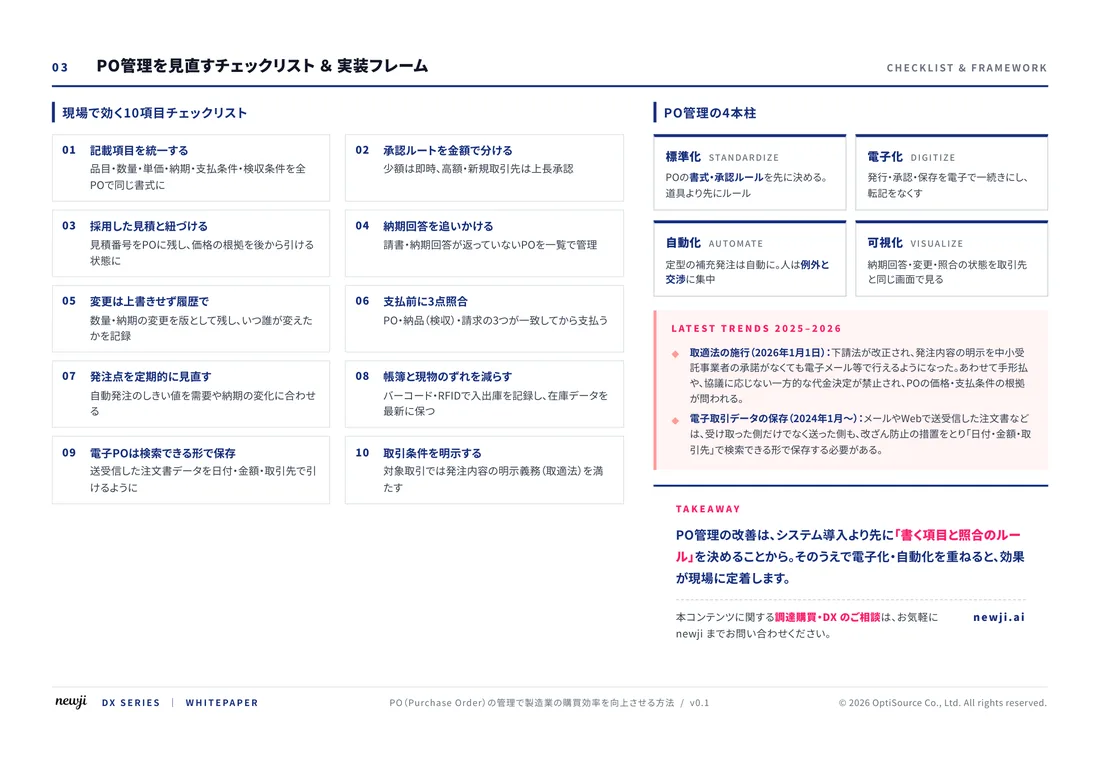
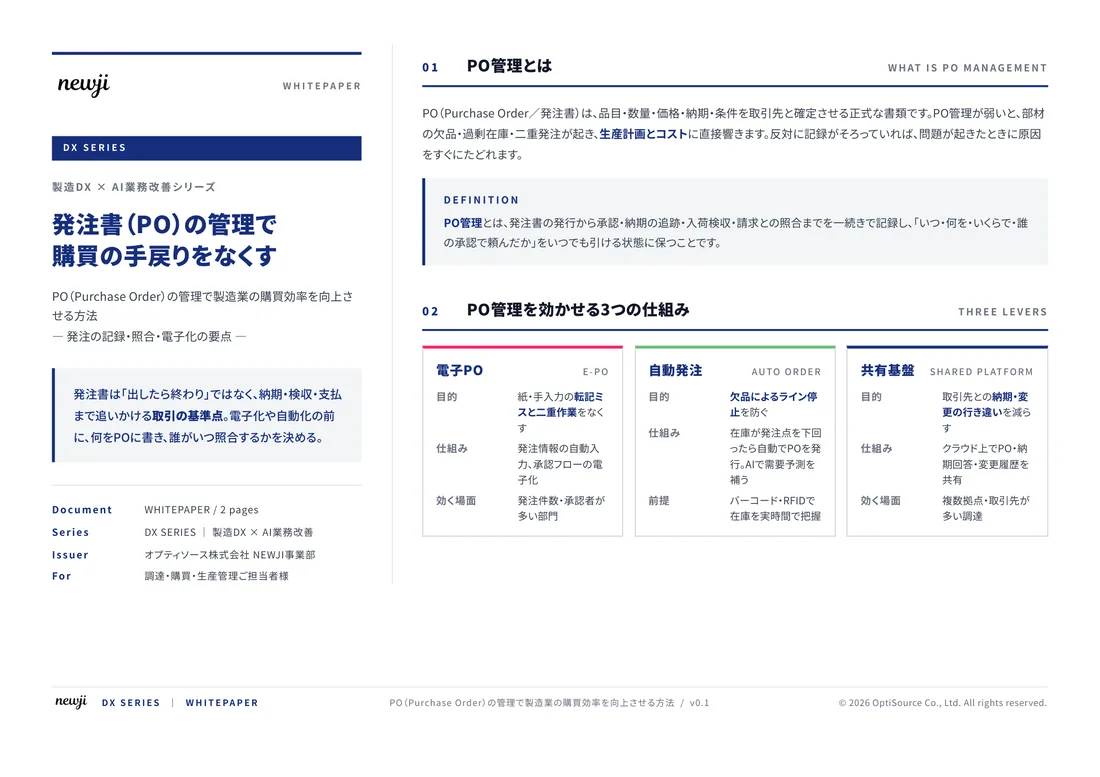
FREE DOCUMENT — サービス資料(PDF・無料)
製造業の見積・受発注クラウド
「Newji one」とは
Newji one は、製造業の調達・受発注に特化したクラウド/AIエージェント。見積依頼・発注書作成・進捗管理・承認をひとつの画面に集約し、AIが比較と異常検知を担当。最後の「GO」だけ人が押す仕組みです。
▶ 製造業の見積・受発注クラウド「Newji one」を、資料で見る(PDF・無料)
- 見積〜発注〜納期を一元管理。催促・転記のムダをゼロに
- AIが相見積もり比較と異常検知。あなたは判断だけに集中
- 取引先は「招待」で完全無料。自社コストだけで取引先ごとデジタル化
※ 取引先から招待された企業様は完全無料でご利用いただけます
関連記事
-

Transforming Modern Electronics: Unleashing the Potential of Silicon-on-Insulator (SOI) Technology for Enhanced Industry Recognition and Market Expansion
-

VLSI(Very Large Scale Integration)の技術と製造業への影響
-

Quality Management Innovation AI and Machine Learning Solving Manufacturing Quality Challenges
-
粘度指数 (Viscosity Index) の評価と製造業での利用方法
-
キッチンスケール(Kitchen Scale)のOEM製造で正確な計量を実現する方法
-

Monday.comで構築!製造業の生産スケジュール管理
 NEWJI総研
 OEM/ODM 生産委託
 AI/DX支援
 見積・発注クラウド Newji one
受発注が増えるほど、入力・確認・催促が重くなる。
受発注管理を“仕組み化“して、ミスと工数を削減しませんか。
見積・発注・納期まで一元管理できます。