

- お役立ち記事
- Creation and improvement of OJT/work/operation manuals and their implementation

Creation and improvement of OJT/work/operation manuals and their implementation

目次
Understanding OJT, Work, and Operation Manuals
On-the-Job Training (OJT) and the development of comprehensive work and operation manuals play significant roles in ensuring efficient workplace operations.
When these tools are implemented correctly, they act as guides to help workers perform their duties accurately and efficiently.
What Is an OJT?
OJT, which stands for On-the-Job Training, is a hands-on method of teaching skills and knowledge in the workplace.
Rather than traditional classroom-based learning, OJT allows employees to gain practical experience directly related to their job role.
This type of training is valuable as it provides real-world experience, helping employees apply skills and knowledge in real-time.
Importance of OJT in the Workplace
OJT is crucial because it allows employees to quickly adapt to the job environment, trial new skills in a practical setting, and observe how their roles tie into larger organizational goals.
Moreover, because OJT is conducted within the actual work environment, training is often more relevant and immediately applicable than in abstract classroom settings.
Benefits of Effective OJT Programs
1. **Increased Skill Acquisition:** Employees gain skills unique to company operations.
2. **Higher Retention Rates:** Practical training leads to better understanding and retention.
3. **Cost-Effectiveness:** Economical compared to formal training programs.
4. **Immediate Productivity:** Employees quickly become productive members of the team.
Creating and Improving Work Manuals
Work manuals are foundational documents that describe detailed policies, procedures, and instructions necessary for performing tasks in the workplace.
These documents are essential in training new employees and ensuring consistent standards across all operations.
The Process of Creating a Work Manual
The creation of a work manual begins with a comprehensive analysis of all tasks and operations within the organization.
Including inputs from experienced employees during this stage ensures that all aspects of a job are covered.
The following steps outline the general process:
1. **Identify Key Work Processes:** Determine critical operations that require standardization.
2. **Collaborate with Employees:** Gather input and insights from team members who perform the tasks daily.
3. **Draft Procedures and Instructions:** Create detailed descriptions of steps involved in each task.
4. **Review and Refine Content:** Ensure clarity, conciseness, and accuracy by reviewing drafts with stakeholders.
5. **Standardize Formatting:** Use consistent and reader-friendly formatting for accessibility.
Implementing and Maintaining Operation Manuals
Operation manuals are not static documents; they require regular updating to remain useful and effective.
Implementing these manuals involves training personnel on changes and revisions while continuously seeking improvements.
Best Practices for Implementation
1. **Conduct Thorough Training:** Immersive training sessions help introduce and reinforce manual usage.
2. **Incorporate Feedback:** Solicit feedback from users to identify potential improvements or updates.
3. **Regular Updates:** Keep operations manuals current with organizational changes or industry developments.
4. **Leverage Technology:** Utilize digital platforms for easier access and distribution.
Challenges in Creating OJT and Manuals
While the creation and implementation of OJT and manuals have benefits, they are not without challenges.
These include keeping content updated, ensuring consistency, and engaging employees in training programs.
Addressing Common Challenges
– **Keeping Content Fresh:** Regularly review and update manuals to reflect current procedures and technologies.
– **Ensuring Consistency:** Assign dedicated teams to oversee content development for consistency and coherence.
– **Employee Engagement:** Utilize interactive and scenario-based methods to make training sessions more engaging and impactful.
Conclusion
The creation and improvement of OJT, work, and operation manuals are crucial investments for any organization aiming for operational excellence.
When effectively designed and implemented, they not only facilitate the onboarding of new employees but also help maintain high standards in service delivery.
Emphasizing structured training programs and comprehensive manuals translates to improved employee performance and increased productivity.
By addressing the potential challenges and leveraging technology for implementation, organizations can maximize the benefits of these critical resources.
この記事の理解を深める
無料ホワイトペーパーをプレゼント
製造業の現場で使える実務資料(PDF)を無料でお届けします。"こんな資料が届きます" ↓ 下のボタンからどうぞ。
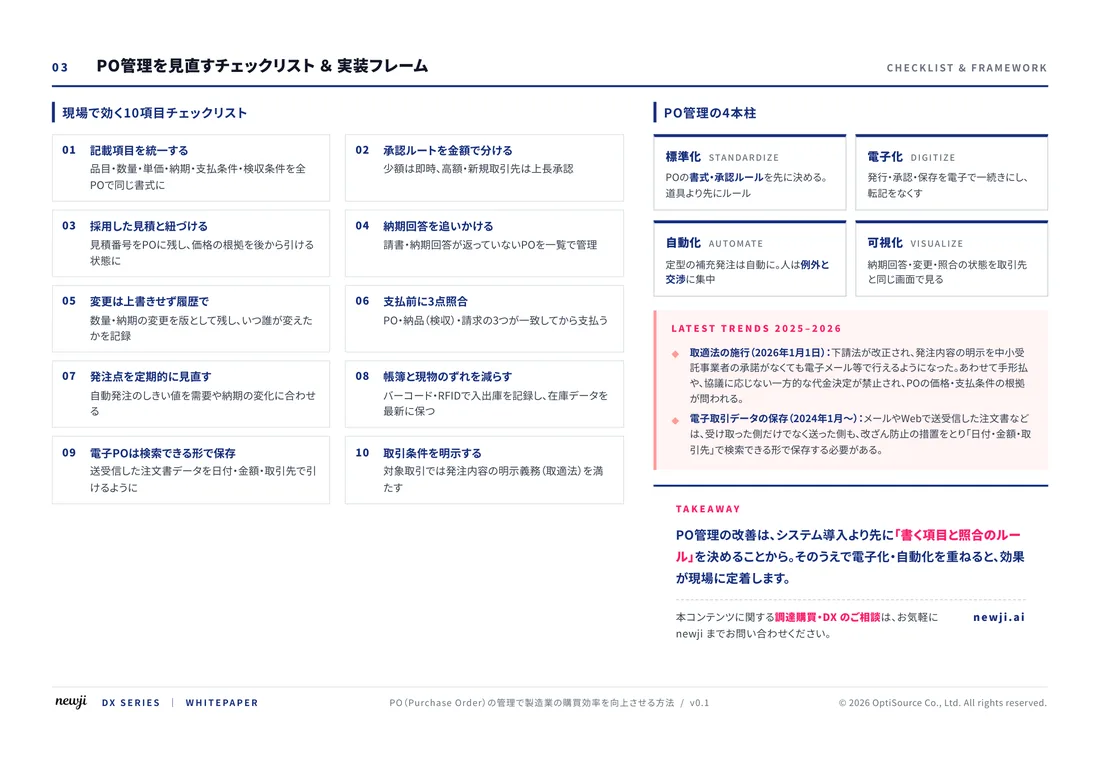
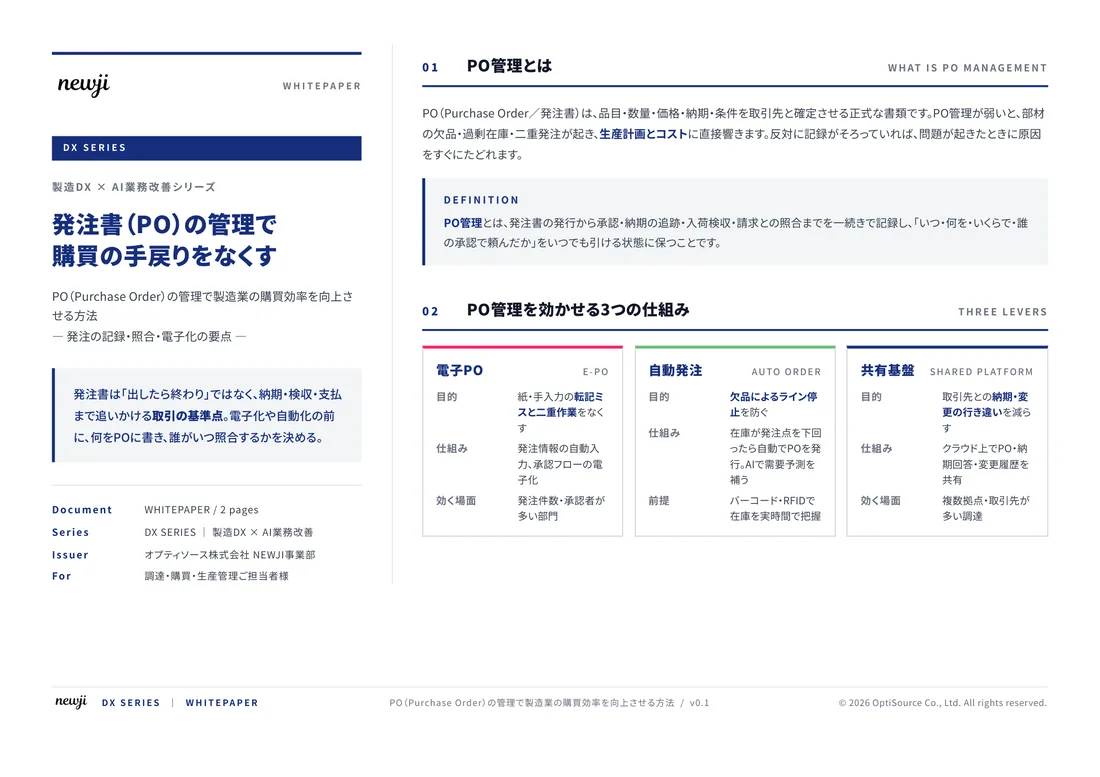
FREE DOCUMENT — サービス資料(PDF・無料)
製造業の見積・受発注クラウド
「Newji one」とは
Newji one は、製造業の調達・受発注に特化したクラウド/AIエージェント。見積依頼・発注書作成・進捗管理・承認をひとつの画面に集約し、AIが比較と異常検知を担当。最後の「GO」だけ人が押す仕組みです。
▶ 製造業の見積・受発注クラウド「Newji one」を、資料で見る(PDF・無料)
- 見積〜発注〜納期を一元管理。催促・転記のムダをゼロに
- AIが相見積もり比較と異常検知。あなたは判断だけに集中
- 取引先は「招待」で完全無料。自社コストだけで取引先ごとデジタル化
※ 取引先から招待された企業様は完全無料でご利用いただけます
関連記事
-

OJT/業務/操作マニュアルの作成・改善とその実践
-

Overcoming the Digital Skills Gap in Manufacturing
-

Confronting the Skills Gap Digital Training Programs for Manufacturing
-
Streamlining Worker Training? Innovations in Worker Training in Manufacturing
-
The Fusion of Digital and Reality AR/VR in Manufacturing
-
Ergonomics in Manufacturing! Balancing Worker Health and Productivity
 NEWJI総研
 OEM/ODM 生産委託
 AI/DX支援
 見積・発注クラウド Newji one
受発注が増えるほど、入力・確認・催促が重くなる。
受発注管理を“仕組み化“して、ミスと工数を削減しませんか。
見積・発注・納期まで一元管理できます。