

- お役立ち記事
- Fundamentals of controller design and practice of DC motor control using modern control and sliding mode control

Fundamentals of controller design and practice of DC motor control using modern control and sliding mode control

目次
Understanding Controller Design
Controller design is a significant area of study in the field of control systems engineering.
It involves creating devices that manage, command, direct, or regulate the behavior of other devices or systems.
Controllers are pivotal in automation and robotics, where they ensure that systems operate efficiently and precisely.
The process of designing a controller begins with understanding the system that needs to be controlled.
This typically involves modeling the system, which is usually done using mathematical equations that describe its dynamics.
In the case of DC motors, this might include considering factors such as resistance, inductance, and the magnetic field.
Modeling the DC Motor
DC motors, or Direct Current motors, are widely used in various applications due to their simplicity and efficiency.
Understanding their behavior is crucial for designing effective control systems.
A DC motor can be modeled using a set of differential equations that represent the relationship between the current, voltage, torque, and speed.
In essence, the DC motor control problem consists of regulating the speed of the motor.
This is often achieved by adjusting the voltage applied to the motor, which in turn controls the current and thereby the torque and speed.
The Basics of Modern Control
Modern control theory extends beyond classical techniques by using state space representations of systems.
Instead of just focusing on input-output relations, modern control considers the internal state of a system.
This is particularly useful for systems with multiple inputs and outputs or systems that are described by complex dynamics.
Using state space models, a control engineer can design controllers that are robust, meaning they can maintain performance even in the presence of uncertainties or disturbances.
This is achieved through feedback control, where measurements from the system’s output are fed back into the controller to adjust the input in real-time.
Implementing Sliding Mode Control
Sliding mode control (SMC) is a type of robust control method that can handle nonlinearities and uncertainties in a system.
It works by forcing the system to “slide” along a predetermined trajectory, known as the sliding surface.
The control signal is switched rapidly, creating a chattering effect that helps the system maintain the desired trajectory.
The strength of SMC lies in its ability to deal with systems that have varying dynamics or are exposed to external disturbances.
This makes it particularly suitable for DC motor control, where load changes and external factors can affect performance.
Benefits of Sliding Mode Control for DC Motors
Sliding mode control offers several advantages for DC motor applications.
Firstly, it provides robustness against parameter variations.
DC motors often experience changes in parameters like resistance and inductance due to temperature shifts or wear and tear.
SMC can adapt to these changes without significant loss of performance.
Secondly, sliding mode control is effective against external disturbances.
Whether it’s frictional forces or unexpected loads, SMC can help the motor maintain its speed and efficiency.
Finally, SMC offers simplicity in implementation.
Despite its sophisticated theoretical background, sliding mode control can be implemented with relatively simple hardware, making it an attractive choice for many engineers.
Integrating Modern Control with Sliding Mode Control
By combining modern control practices with sliding mode control, engineers can develop highly effective controller systems for DC motors.
This involves leveraging the state space representation of modern control to understand the system’s dynamics deeply and then applying SMC for robustness.
Such an integrative approach ensures that the controller is not only designed for optimal performance but also resilient to practical challenges.
Practical Steps for Designing Controllers
The process of designing controllers using these techniques involves several key steps:
1. **System Identification:** Begin by identifying and understanding the dynamics of the DC motor. Use mathematical models to capture the behavior of the motor under different conditions.
2. **Developing the State Space Model:** Use the identified system equations to develop a state space model, which will serve as the foundation for controller design.
3. **Controller Design:** Apply modern control techniques to design a controller using state feedback control. Enforce stability and performance criteria to ensure the controller performs as expected.
4. **Integrating SMC:** Incorporate sliding mode control components to enhance robustness. Define a sliding surface and ensure the control law is capable of maintaining system behavior along this surface.
5. **Simulation and Testing:** Use simulation tools to test the designed controller under various scenarios. Validate its performance and robustness against disturbances and parameter variations.
6. **Implementation:** After thorough testing, implement the controller on the actual DC motor system. Monitor its performance and make adjustments if necessary.
Conclusion
The fundamentals of controller design and DC motor control using modern control and sliding mode control offer powerful tools for engineers.
By understanding the dynamics of the system, applying state space models, and integrating robust control strategies, we can achieve precise and efficient motor control.
This fusion of theory and practice not only advances technology but also ensures more reliable and adaptable systems in the field of automation and robotics.
この記事の理解を深める
無料ホワイトペーパーをプレゼント
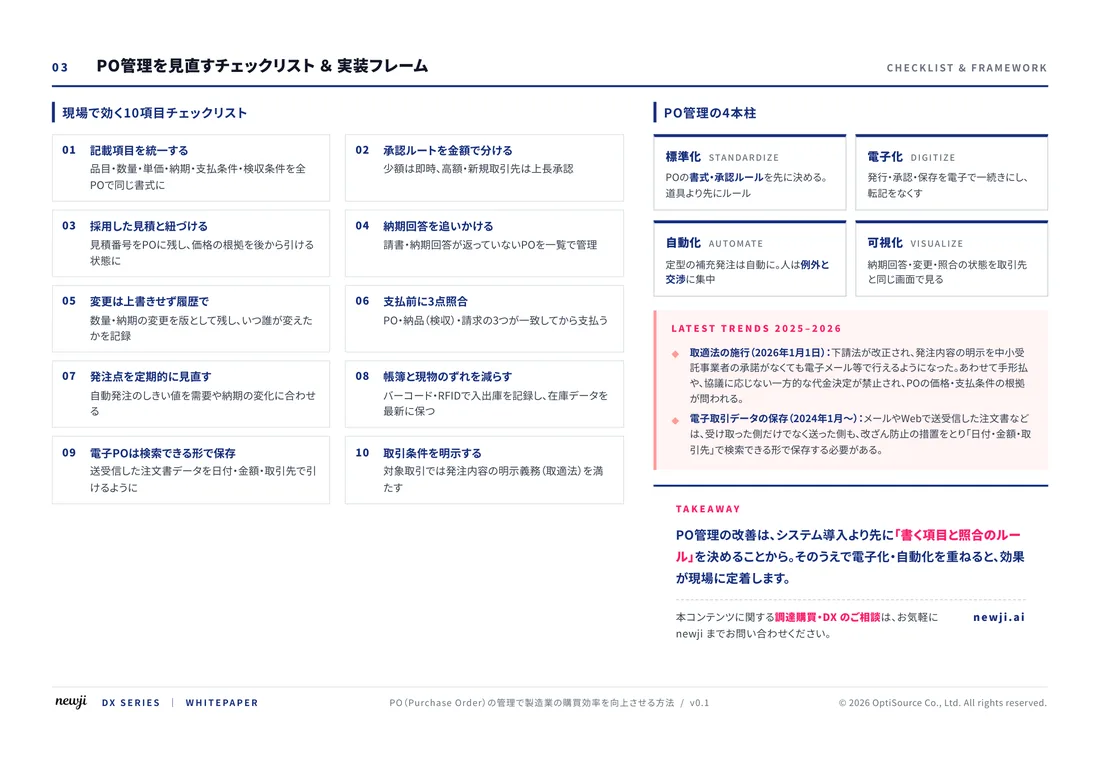
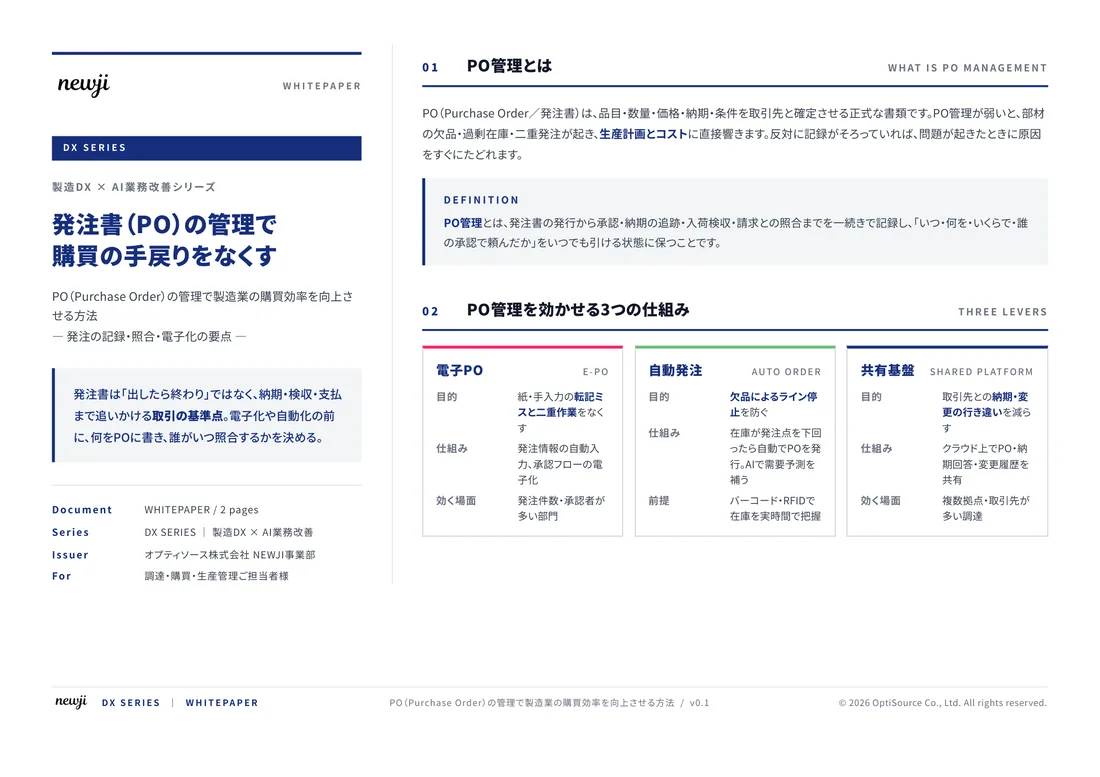
製造業の現場で使える実務資料(PDF)を無料でお届けします。"こんな資料が届きます" ↓ 下のボタンからどうぞ。
FREE DOCUMENT — サービス資料(PDF・無料)
製造業の見積・受発注クラウド
「Newji one」とは
Newji one は、製造業の調達・受発注に特化したクラウド/AIエージェント。見積依頼・発注書作成・進捗管理・承認をひとつの画面に集約し、AIが比較と異常検知を担当。最後の「GO」だけ人が押す仕組みです。
▶ 製造業の見積・受発注クラウド「Newji one」を、資料で見る(PDF・無料)
- 見積〜発注〜納期を一元管理。催促・転記のムダをゼロに
- AIが相見積もり比較と異常検知。あなたは判断だけに集中
- 取引先は「招待」で完全無料。自社コストだけで取引先ごとデジタル化
※ 取引先から招待された企業様は完全無料でご利用いただけます




 NEWJI総研
 OEM/ODM 生産委託
 AI/DX支援
 見積・発注クラウド Newji one
受発注が増えるほど、入力・確認・催促が重くなる。
受発注管理を“仕組み化“して、ミスと工数を削減しませんか。
見積・発注・納期まで一元管理できます。