

- お役立ち記事
- Differences in printability and processing technology between paper and plastic film

Differences in printability and processing technology between paper and plastic film

目次
Introduction to Printability and Processing Technologies
When it comes to printing technologies, the choice of material is crucial.
Paper and plastic films are two commonly used media, each with its own set of properties that influence printability and processing methods.
Understanding these differences is important for anyone involved in printing, packaging, or any related industry.
What is Printability?
Printability refers to how well a material can receive and hold ink or any other printing medium.
It involves factors like ink absorption, surface smoothness, and adhesion properties.
The printability of a material directly affects the quality and durability of the printed image or text.
Printability of Paper
Paper has been a traditional medium in the printing industry for centuries.
Its printability is influenced by several factors such as surface gloss, smoothness, and fiber composition.
Surface Texture and Absorption
The surface texture of paper can vary from rough to smooth, affecting how ink is absorbed.
Smooth surfaces tend to provide better print quality as they allow for uniform ink distribution.
In contrast, rough surfaces may result in uneven ink spread, leading to less sharp images.
Ink Absorption
Absorption is another important aspect.
Some papers are highly absorbent which can cause ink to spread more than desired, resulting in blurred images.
Others are coated to control absorption, ensuring sharper prints with vibrant colors.
Printability of Plastic Film
Plastic films offer different printability characteristics compared to paper.
They are commonly used for flexible packaging, labels, and various types of decorative applications.
Smoothness and Clarity
Plastic films generally have a smoother surface compared to paper, which can result in higher quality prints with sharp lines and vibrant colors.
This inherent smoothness allows for better ink adhesion and distribution.
Non-Absorbent Nature
Unlike paper, plastic films are non-absorbent.
This characteristic necessitates the use of special inks and treating processes to ensure good adhesion.
Printing on plastic often involves pre-treatment steps like corona discharge or flame treatment to modify surface properties and enhance printability.
Processing Technologies for Paper
Offset Printing
Offset printing is a popular choice for high-volume paper printing.
It offers consistent printing quality and is cost-effective for large runs.
The process involves transferring an inked image from a plate to a rubber blanket and then to the printing surface.
Digital Printing
Digital printing technologies have rapidly advanced, offering fast turnaround times and the ability to customize prints easily.
This technology is suitable for small to medium print runs and provides high-quality results on a variety of paper stocks.
Processing Technologies for Plastic Film
Flexographic Printing
Flexographic printing is widely used for printing on plastic films.
It utilizes flexible plates and fast-drying inks, making it ideal for high-speed production runs.
This method is suitable for printing on various substrates besides plastic, including paper and foil.
Gravure Printing
Gravure printing is another technique used for plastic films, particularly when high-quality and consistent print results are required.
This method involves engraving the image onto a cylinder, which is then transferred to the film.
It’s a cost-effective choice for long runs due to its durability.
Environmental Considerations
Both paper and plastic films present unique environmental considerations.
Paper is generally more eco-friendly and recyclable but requires sustainable sourcing from forests.
Plastic films, on the other hand, pose challenges due to their non-biodegradable nature, although advancements are being made in developing recyclable plastic materials.
Conclusion
Choosing between paper and plastic films for printing requires a deep understanding of their respective printability and processing characteristics.
Paper offers a traditional and eco-friendlier option with various advantages in textural printing.
Plastic films provide high-quality print results with specialized processing techniques but require considerations for environmental impact.
Ultimately, the application’s specific needs and goals will determine the best material and processing technology to use. Understanding these differences can guide better decision-making in the selection and use of print materials.
この記事の理解を深める
無料ホワイトペーパーをプレゼント
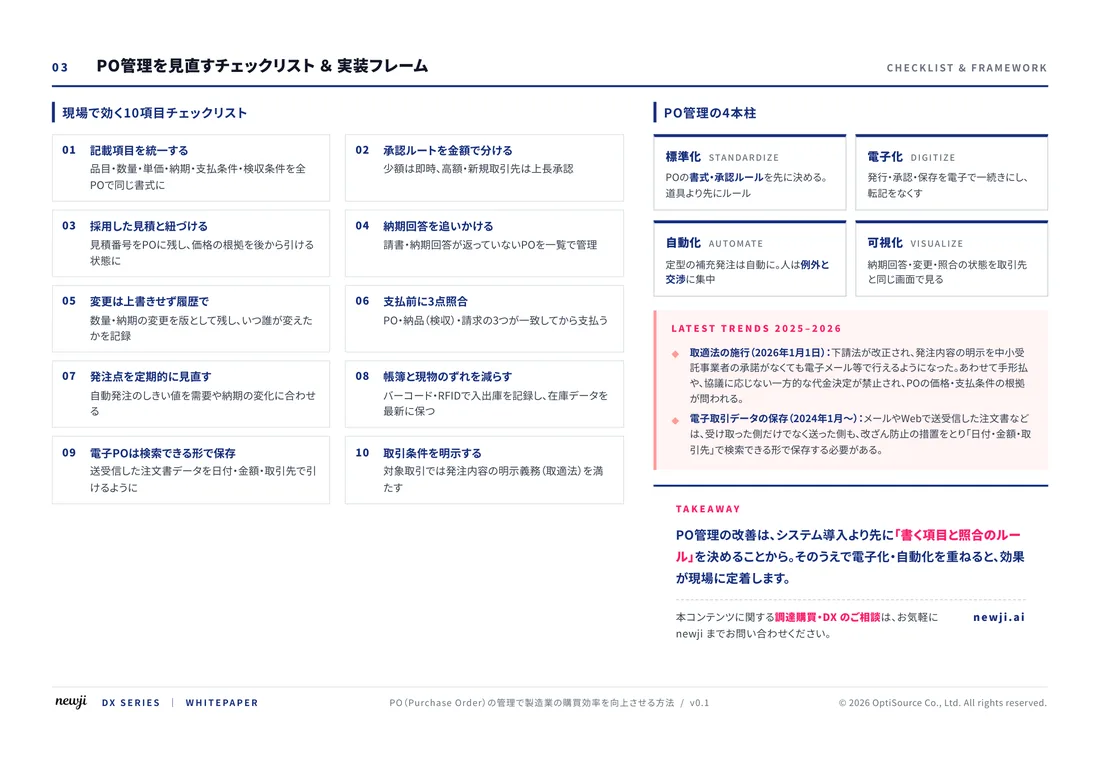
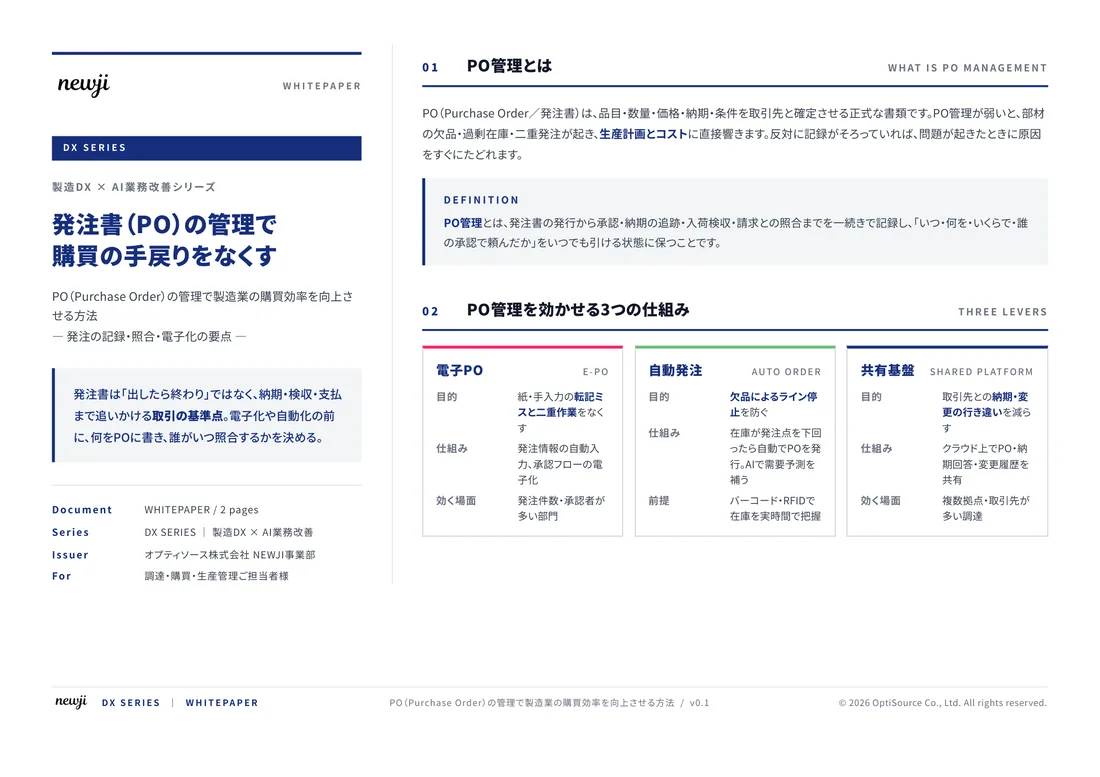
製造業の現場で使える実務資料(PDF)を無料でお届けします。"こんな資料が届きます" ↓ 下のボタンからどうぞ。
FREE DOCUMENT — サービス資料(PDF・無料)
製造業の見積・受発注クラウド
「Newji one」とは
Newji one は、製造業の調達・受発注に特化したクラウド/AIエージェント。見積依頼・発注書作成・進捗管理・承認をひとつの画面に集約し、AIが比較と異常検知を担当。最後の「GO」だけ人が押す仕組みです。
▶ 製造業の見積・受発注クラウド「Newji one」を、資料で見る(PDF・無料)
- 見積〜発注〜納期を一元管理。催促・転記のムダをゼロに
- AIが相見積もり比較と異常検知。あなたは判断だけに集中
- 取引先は「招待」で完全無料。自社コストだけで取引先ごとデジタル化
※ 取引先から招待された企業様は完全無料でご利用いただけます




 NEWJI総研
 OEM/ODM 生産委託
 AI/DX支援
 見積・発注クラウド Newji one
受発注が増えるほど、入力・確認・催促が重くなる。
受発注管理を“仕組み化“して、ミスと工数を削減しませんか。
見積・発注・納期まで一元管理できます。