

- お役立ち記事
- Fundamentals of particle filters and applications to object tracking and robot position estimation

Fundamentals of particle filters and applications to object tracking and robot position estimation

目次
Introduction to Particle Filters
Particle filters are powerful tools used in various fields such as robotics, signal processing, and computer vision.
Their main application lies in estimating the state of a dynamic system, which is usually not directly observable.
At their core, particle filters use a set of random samples, called particles, to approximate the probability distribution of a system’s state.
These particles are then updated and refined over time, as new observations are made, to improve the accuracy of the state estimation.
How Particle Filters Work
The process begins with the initialization of the particles, which are randomly distributed across the entire state space of the system.
Each particle represents a potential state that the system might be in at any given time.
As the system evolves and new data becomes available, these particles are updated according to a set of rules.
The key steps in this process include prediction, updating, and resampling.
Prediction Step
During the prediction step, each particle’s state is projected forward in time using a model of the system’s dynamics.
This model might include information about the system’s velocity, direction, or other relevant parameters that affect its state.
The prediction step helps spread the particles around likely state spaces based on the system’s expected behavior.
Update Step
In the update step, the particle filter incorporates new observations to refine the particle set.
Each particle is assigned a weight based on how well it matches the new observation.
The weight represents the probability of the particle being the accurate state of the system.
This step helps the filter to discard unlikely states and focus on the more promising ones.
Resampling Step
After the update step, resampling is performed to retain particles with higher weights while discarding those with lower probabilities.
This step prevents the filter from being dominated by particles that do not reflect the current state accurately.
Through resampling, the filter focuses its resources on the most likely states, ensuring robustness in state estimation.
Applications of Particle Filters in Object Tracking
Particle filters are particularly effective in object tracking tasks, such as following a moving object through a sequence of video frames.
When implemented for object tracking, particle filters provide a robust framework to estimate the location and motion parameters of the object.
Visual Tracking
In visual tracking, a particle filter can adjust to the object’s motion and lighting conditions by maintaining a hypothesis over a range of possible object appearances.
As the object moves across different frames, the filter updates the particles to improve the accuracy of the location estimate.
This dynamic adjustment enables real-time object tracking even in complex environments where the object may undergo occlusions or rapid movement.
Monitoring Multiple Objects
Particle filters can also be extended to track multiple objects simultaneously.
By maintaining a separate filter for each object, or by using a multi-target tracking framework, particle filters help solve complex tracking problems.
This capability is particularly useful in surveillance systems or crowd monitoring, where many objects need to be tracked concurrently.
Applications in Robot Position Estimation
Beyond object tracking, particle filters are widely used in robotic systems to estimate a robot’s position and orientation, a process known as localization.
In robotics, accurate localization is crucial for navigation and interaction with the environment.
Mobile Robot Localization
For mobile robots operating in dynamic environments, particle filters help estimate the robot’s position by incorporating data from various sensors.
As the robot moves, particle filters adapt to new information from sensors like GPS, LIDAR, and odometry to refine position estimates.
This allows the robot to navigate accurately, even in the presence of noise and uncertainty.
Simultaneous Localization and Mapping (SLAM)
Particle filters play a key role in SLAM, a challenging problem in robotics where a robot must simultaneously estimate its position and map the environment.
In SLAM, particle filters help manage the estimation of both the robot’s trajectory and the map’s features efficiently.
This enables robots to explore unknown environments while building accurate maps for future use.
Challenges and Future Directions
Despite their advantages, particle filters face challenges such as computational load and handling high-dimensional spaces.
As the complexity of the system increases, tracking and localization require more particles, which can be computationally expensive.
Researchers are continually exploring ways to improve particle filter algorithms to enhance their efficiency without compromising accuracy.
In the future, advances in computation power and algorithm optimization are likely to further broaden the range of particle filter applications.
This may include integrating more sophisticated sensor data and handling increasingly complex dynamic systems.
Conclusion
Particle filters remain a powerful and flexible method for state estimation under uncertainty.
Their adaptability to a range of applications, from object tracking to robot localization, demonstrates their importance in modern technological fields.
By continuing to refine particle filter techniques, scientists and engineers are set to unlock even greater potential in solving dynamic and complex problems.
この記事の理解を深める
無料ホワイトペーパーをプレゼント
製造業の現場で使える実務資料(PDF)を無料でお届けします。"こんな資料が届きます" ↓ 下のボタンからどうぞ。
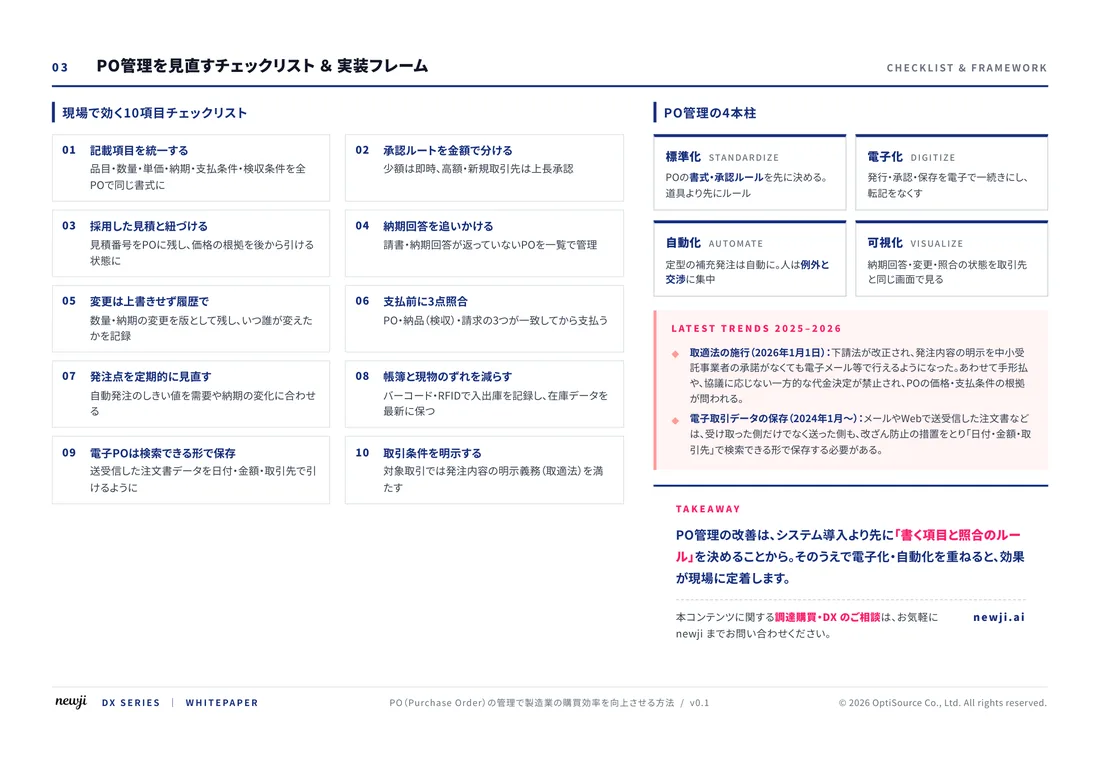
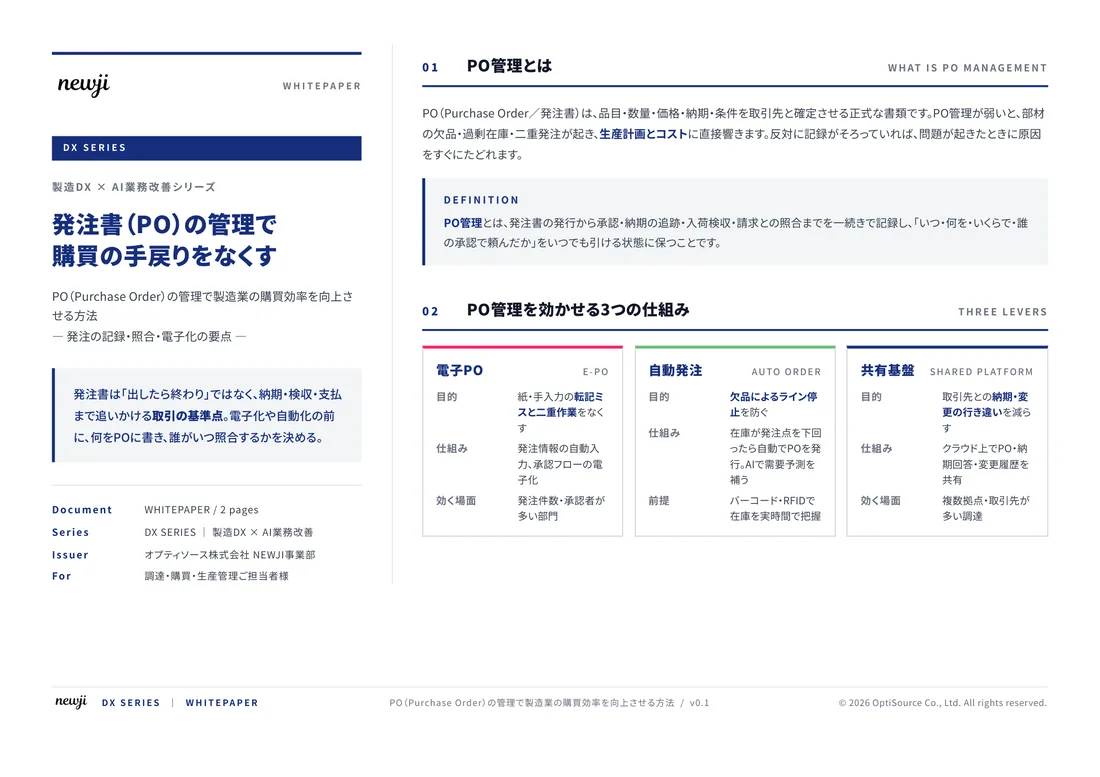
FREE DOCUMENT — サービス資料(PDF・無料)
製造業の見積・受発注クラウド
「Newji one」とは
Newji one は、製造業の調達・受発注に特化したクラウド/AIエージェント。見積依頼・発注書作成・進捗管理・承認をひとつの画面に集約し、AIが比較と異常検知を担当。最後の「GO」だけ人が押す仕組みです。
▶ 製造業の見積・受発注クラウド「Newji one」を、資料で見る(PDF・無料)
- 見積〜発注〜納期を一元管理。催促・転記のムダをゼロに
- AIが相見積もり比較と異常検知。あなたは判断だけに集中
- 取引先は「招待」で完全無料。自社コストだけで取引先ごとデジタル化
※ 取引先から招待された企業様は完全無料でご利用いただけます

 NEWJI総研
 OEM/ODM 生産委託
 AI/DX支援
 見積・発注クラウド Newji one
受発注が増えるほど、入力・確認・催促が重くなる。
受発注管理を“仕組み化“して、ミスと工数を削減しませんか。
見積・発注・納期まで一元管理できます。