

- お役立ち記事
- Fundamentals of ROS2, autonomous mobile system development, and application to actual machines

Fundamentals of ROS2, autonomous mobile system development, and application to actual machines

目次
Introduction to ROS2
ROS2, or Robot Operating System 2, is an open-source framework that provides essential tools and libraries for developing robot applications.
Its design facilitates communication between robot components, enhancing modularity and performance.
ROS2 emerged as an improvement over its predecessor, ROS1, addressing limitations like real-time processing capabilities and system security.
An autonomous mobile system is a machine that can perform tasks without human intervention.
These systems rely on advanced algorithms and sensors to navigate and make decisions.
ROS2 supports these systems by offering a flexible framework to integrate various sensors, actuators, and computational services.
Benefits of Using ROS2
One significant advantage of ROS2 is its cross-platform support.
It functions on various operating systems, including Linux, Windows, and macOS, making it widely accessible for developers.
Moreover, ROS2 supports multiple programming languages, such as C++ and Python.
This flexibility allows developers to use their preferred language, facilitating ease of coding and integration with other tools.
Another key benefit is the improved middleware.
Using Data Distribution Service (DDS) as the communication backbone, ROS2 ensures data is efficiently conveyed between components, enhancing real-time performance and reliability.
Developing Autonomous Mobile Systems
The development of autonomous systems consists of several crucial stages.
Defining Requirements
Initially, developers must clearly outline the system’s requirements.
Understanding the objective—whether it’s for navigation, object detection, or manipulation—guides the subsequent steps.
System Architecture Design
Designing the system architecture involves selecting suitable hardware components, including sensors like LIDAR and cameras, and onboard processors.
The architecture must support efficient data processing and communication between components.
Algorithm Development
Algorithms are at the core of autonomous systems.
Developers must choose and implement algorithms for tasks like path planning, environmental mapping, and obstacle avoidance.
These tasks typically involve advanced mathematical models and machine learning.
ROS2 can significantly streamline algorithm development with its rich library of pre-existing algorithms and development tools.
Simulation and Testing
Before deploying to physical machines, simulations help refine and test the system’s capabilities.
ROS2 supports Gazebo and other simulation environments, enabling virtual testing of different scenarios and ensuring the system behaves as expected.
Integration and Iterative Testing
After simulations, integrating the software with the actual machine is vital.
This involves hardware interfacing, calibrating sensors, and verifying system responses under real-world conditions.
Iterative testing helps identify and rectify unforeseen issues, improving system robustness.
Applying ROS2 to Real-World Machines
Deploying ROS2-based systems onto actual machines involves several real-world applications.
Industry
In industrial settings, robots equipped with ROS2 are used for tasks such as inventory management, material transport, and assembly.
The adaptability of ROS2 allows these robots to operate efficiently in dynamic environments, optimizing productivity and reducing downtime.
Agriculture
Agricultural robots leverage ROS2 to perform tasks like planting, harvesting, and monitoring crop health.
By using sensors and cameras integrated through ROS2, these robots operate autonomously, enhancing precision agriculture practices.
Healthcare
In healthcare, ROS2 robots provide services like patient assistance and medication delivery.
These robots must navigate complex environments safely, which ROS2 supports through robust algorithms and communication protocols.
Transportation
Autonomous vehicles, including drones and self-driving cars, utilize ROS2 for navigation and control systems.
The framework allows these vehicles to process extensive sensor data in real-time, making informed decisions for safe and efficient travel.
Challenges in Autonomous System Development
Developing autonomous systems with ROS2 does present challenges.
Complexity
The complexity of integrating diverse hardware and software components can be daunting.
Developers need profound knowledge of both robotics and the tools provided by ROS2 to achieve desired outcomes.
Resource Limitations
Hardware constraints, such as processing power and sensor capabilities, can limit system performance.
Balancing these constraints with system requirements demands careful planning and optimization.
Security Concerns
As autonomous systems often operate in sensitive environments, security is paramount.
Ensuring secure communication and protecting data from unauthorized access is a continuous concern.
ROS2 introduces improved security features over ROS1, yet developers must remain vigilant to potential threats.
Future of ROS2 and Autonomous Systems
The future of autonomous systems and ROS2 is promising, with ongoing advances in technology and robotics.
Developments in artificial intelligence and machine learning are enabling more sophisticated algorithms, enhancing the decision-making capabilities of autonomous systems.
The continuous improvement and community collaboration on ROS2 mean it will likely remain a cornerstone in robotic development.
In the coming years, improved hardware and communication technologies, like 5G, will further propel the capabilities of ROS2-based autonomous systems.
These innovations will facilitate new applications and make existing systems more efficient, secure, and user-friendly.
As industries and domains continue to embrace automation, the skills and knowledge associated with ROS2 and autonomous system development will be increasingly in demand.
Developers and engineers will benefit from staying informed of the latest trends and practices in this dynamic field.
この記事の理解を深める
無料ホワイトペーパーをプレゼント
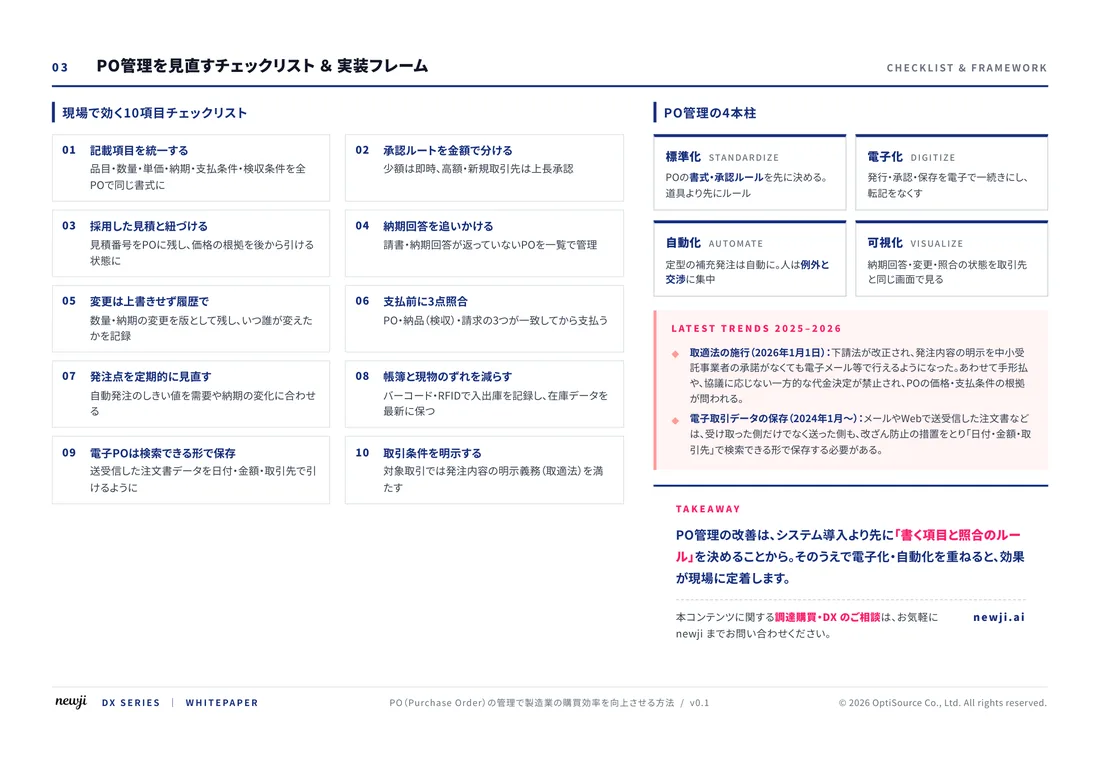
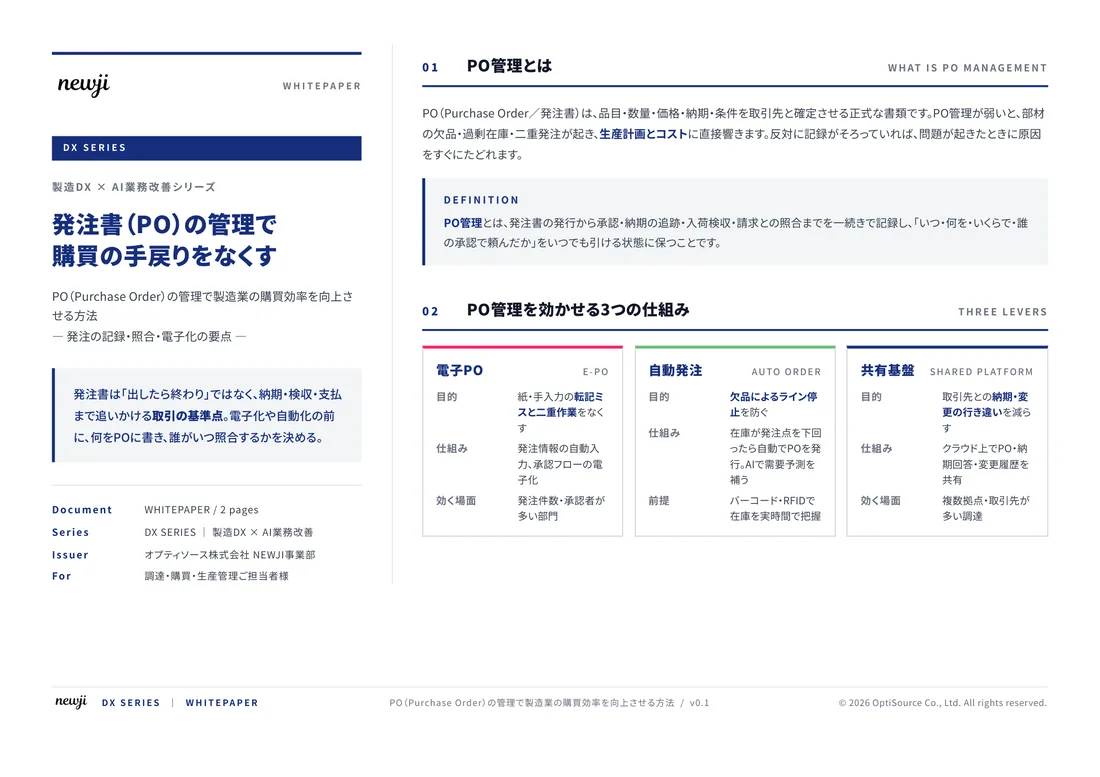
製造業の現場で使える実務資料(PDF)を無料でお届けします。"こんな資料が届きます" ↓ 下のボタンからどうぞ。
FREE DOCUMENT — サービス資料(PDF・無料)
製造業の見積・受発注クラウド
「Newji one」とは
Newji one は、製造業の調達・受発注に特化したクラウド/AIエージェント。見積依頼・発注書作成・進捗管理・承認をひとつの画面に集約し、AIが比較と異常検知を担当。最後の「GO」だけ人が押す仕組みです。
▶ 製造業の見積・受発注クラウド「Newji one」を、資料で見る(PDF・無料)
- 見積〜発注〜納期を一元管理。催促・転記のムダをゼロに
- AIが相見積もり比較と異常検知。あなたは判断だけに集中
- 取引先は「招待」で完全無料。自社コストだけで取引先ごとデジタル化
※ 取引先から招待された企業様は完全無料でご利用いただけます

 NEWJI総研
 OEM/ODM 生産委託
 AI/DX支援
 見積・発注クラウド Newji one
受発注が増えるほど、入力・確認・催促が重くなる。
受発注管理を“仕組み化“して、ミスと工数を削減しませんか。
見積・発注・納期まで一元管理できます。