

- お役立ち記事
- What is digital twin technology that improves productivity in food factories?

What is digital twin technology that improves productivity in food factories?

目次
Understanding Digital Twin Technology
Digital twin technology is a rapidly evolving concept that plays a crucial role in various industries, including the food manufacturing sector.
A digital twin is essentially a virtual replica of a physical object, system, or process.
This replica can be used to simulate, analyze, and optimize the operations of its real-world counterpart.
In the context of food factories, digital twins are employed to enhance productivity, reduce waste, and improve overall efficiency.
How Digital Twins Work
At its core, digital twin technology involves the creation of a digital model that mirrors the physical asset or process in real-time.
This digital model collects data from sensors and devices embedded in the actual factory equipment.
By leveraging advanced technologies such as IoT (Internet of Things), AI (Artificial Intelligence), and ML (Machine Learning), digital twins provide actionable insights to optimize production processes.
The digital twin captures a wide range of data points from the factory floor, including temperature, humidity, machine status, and energy consumption.
This information is then analyzed to identify patterns and predict potential issues before they arise.
As a result, factory managers can proactively address problems, leading to minimized downtime and enhanced productivity.
Advantages of Digital Twin Technology in Food Factories
One of the primary benefits of using digital twin technology in food factories is improved operational efficiency.
By continuously monitoring equipment and processes, factories can implement predictive maintenance strategies.
This means machinery is serviced or repaired just before a failure might occur, thus avoiding unexpected breakdowns.
Additionally, digital twins facilitate better decision-making by providing factory managers with real-time data.
They can quickly adapt to changing demands, optimize resource allocation, and ensure production is running at optimal levels.
This adaptability is vital in the food industry, where consumer preferences and regulatory standards are dynamic.
Another key advantage is enhanced quality control.
Digital twins enable continuous monitoring of production processes, ensuring that every product meets stringent quality standards.
Anomalies can be detected early, and corrective actions can be taken immediately, reducing the risk of defective products reaching consumers.
Reducing Waste and Resource Optimization
Waste reduction is another significant area where digital twin technology can make a considerable impact.
By simulating various production scenarios, digital twins help identify areas where resources can be used more efficiently.
For instance, they can pinpoint where energy consumption can be reduced or where raw materials are being used excessively.
By optimizing these variables, food factories can operate more sustainably, reducing their environmental footprint while cutting costs.
Moreover, precise control over resource utilization also contributes to keeping the production line lean and cost-effective.
Enhancing Supply Chain Visibility
Digital twin technology extends beyond the factory floor and into the supply chain.
By implementing digital twins across the supply chain, manufacturers can gain a comprehensive view of their entire operation.
This visibility is essential for identifying bottlenecks, improving logistics, and ensuring timely delivery of raw materials and finished products.
With digital twins, supply chains become more resilient to disruptions.
For example, if a supplier is delayed, a digital twin can simulate alternative routing options to find the most efficient solution.
This capability enables food factories to maintain production schedules and meet customer demands without significant interruptions.
Challenges and Considerations
While digital twin technology offers numerous benefits, it is not without its challenges.
One challenge is the integration of complex data sets from different sources.
Ensuring accurate and comprehensive data collection is critical, as any discrepancies can lead to incorrect analysis and suboptimal decisions.
Data security is another concern.
As with any digital system, there is a risk of cyber attacks.
Manufacturers must implement robust cybersecurity measures to protect sensitive information and maintain the integrity of their digital twins.
Cost can also be a barrier, especially for smaller food companies.
The initial investment in sensors, IoT devices, and software can be significant.
However, as the technology becomes more widespread and cost-effective, more factories are expected to adopt digital twins to stay competitive.
The Future of Digital Twins in Food Manufacturing
Looking ahead, the role of digital twin technology in food manufacturing is poised to expand further.
With continued advancements in AI and machine learning, digital twins are expected to become even more sophisticated, offering deeper insights and more precise predictions.
The integration of digital twins into smart factories is another exciting development.
In smart factories, real-time data from digital twins can drive autonomous decision-making processes, leading to increased agility and efficiency.
As consumer demand for transparency and sustainability grows, digital twins can also enhance product traceability.
This feature allows consumers to trace a product’s journey from production to the store shelf, providing them with confidence in the safety and quality of their food.
In conclusion, digital twin technology is revolutionizing the way food factories operate.
By providing real-time insights, optimizing processes, and enhancing supply chain visibility, digital twins are helping the industry boost productivity and meet ever-changing demands.
As technology progresses, digital twins will no doubt play an even more significant role in shaping the future of food manufacturing.
この記事の理解を深める
無料ホワイトペーパーをプレゼント
製造業の現場で使える実務資料(PDF)を無料でお届けします。"こんな資料が届きます" ↓ 下のボタンからどうぞ。
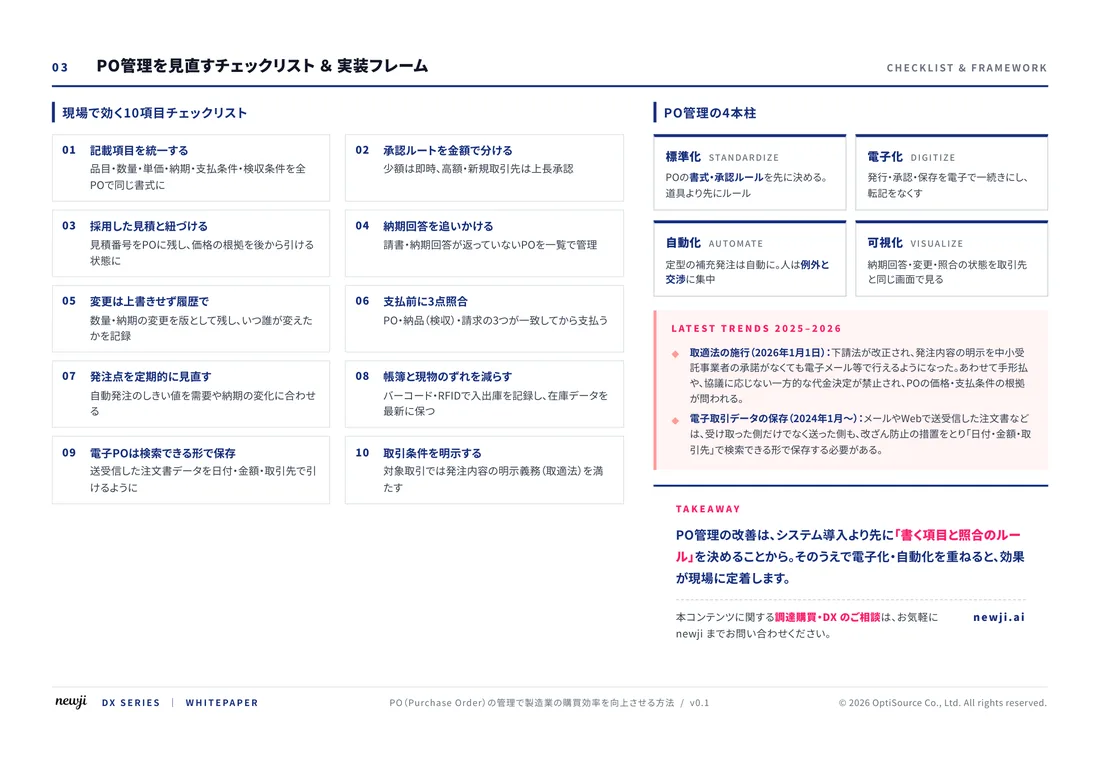
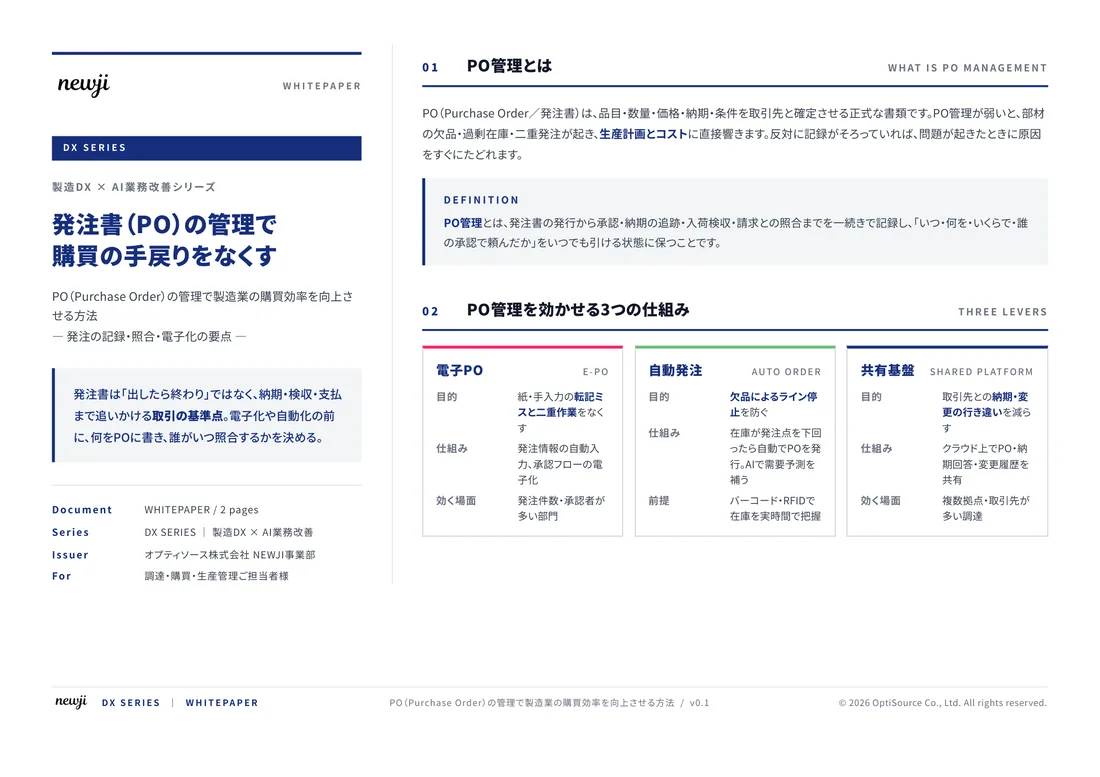
FREE DOCUMENT — サービス資料(PDF・無料)
製造業の見積・受発注クラウド
「Newji one」とは
Newji one は、製造業の調達・受発注に特化したクラウド/AIエージェント。見積依頼・発注書作成・進捗管理・承認をひとつの画面に集約し、AIが比較と異常検知を担当。最後の「GO」だけ人が押す仕組みです。
▶ 製造業の見積・受発注クラウド「Newji one」を、資料で見る(PDF・無料)
- 見積〜発注〜納期を一元管理。催促・転記のムダをゼロに
- AIが相見積もり比較と異常検知。あなたは判断だけに集中
- 取引先は「招待」で完全無料。自社コストだけで取引先ごとデジタル化
※ 取引先から招待された企業様は完全無料でご利用いただけます

 NEWJI総研
 OEM/ODM 生産委託
 AI/DX支援
 見積・発注クラウド Newji one
受発注が増えるほど、入力・確認・催促が重くなる。
受発注管理を“仕組み化“して、ミスと工数を削減しませんか。
見積・発注・納期まで一元管理できます。